Our Tools
Throughout the various stages of our work – the SafeSchools NOLA Project, the Trauma-Informed Learning Collaborative, the Training of Trainers Project, and the Trauma-Informed Schools Project – we have created, implemented, and iterated various tools and resources. These tools and resources are developed based on our research, and the research of others, to support best practices for implementation of trauma-informed, healing-centered approaches in schools.
Our tools are organized below based on the Implementation Stages to help guide you through your trauma-informed schools journey.
Implementation Stages

Exploration
- Assess fit
- Ensure a usable innovation
- Create implementation teams
- Establish practice-policy loop

Installation
- Examine implementation drivers
- Develop practitioner readiness
- Develop fidelity measure

Initial Implementation
- Initiate improvement cycles
- Build capacity for implementation drivers
- Enhance the practice-policy connection
- Assess fidelity

Full Implementation
- Achieve fidelity
- Improve outcomes
- Sustain the practice-policy connection
Implementation Drivers
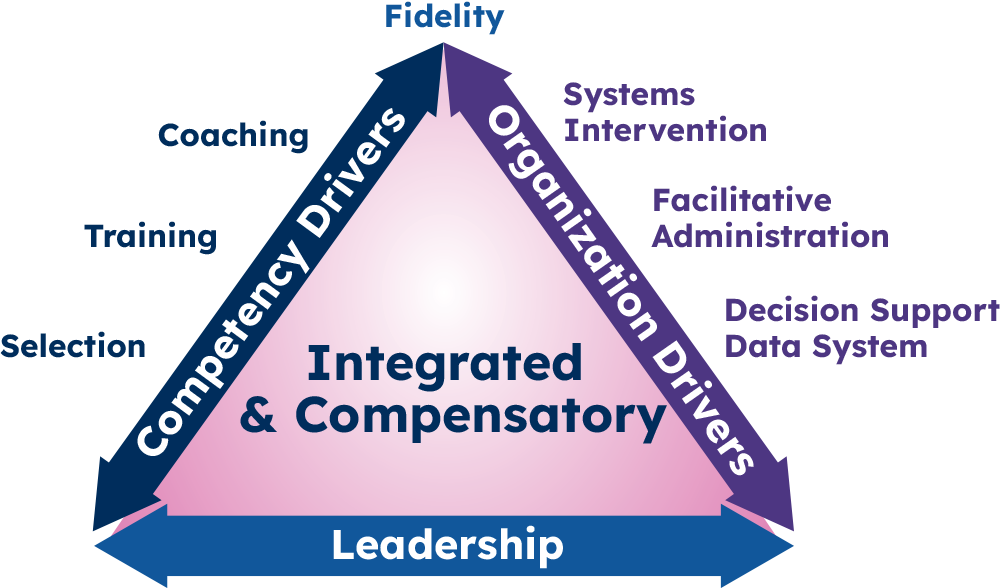
The implementation drivers our research has shown as effective in installing trauma-informed multitiered systems of support include:
- Safe & Supportive Environments
- Preventing Escalation in the Classroom
- Strengthening Relationships
- Universal Screening
- Self/Co-Regulation Strategies
- Educator Wellbeing
- Family & Community Engagement
- Youth Participatory Action Research
These tools are provided, with context for how they have been and can be used, for anyone interested in developing their practice. We ask that you credit and cite our tools
Exploration Stage
Readiness Assessment
Our readiness assessment looks at the domains of General Capacity, Specific Capacity, and Motivation to help assess the fit for implementing trauma-informed changes. This tool also comes with action planning resources to improve readiness. View the readiness assessment page of our website to gain access to the tool online, watch a webinar on how to use it, and receive support with scoring and interpretation.
Policy & Practices Review Checklist
The policy & practices review checklist is good for school and district leadership to establish a practice-policy loop. This tool is designed to help determine the extent to which school policies, protocols, and documents align with the key principles of trauma-informed schools.
Cultural Insights Interview
The cultural insights interview is used to gather information across school teams around five domains: General Impression of School Community, Behavior and Culture Management, Events/Celebrations/Traditions, Social Emotional Learning, and Administrative Support. This helps to understand the practice-policy loop while assessing people’s perceptions of the current school climate and community.
Peer Support Specialist Overview
Peer support specialists are teachers and school staff who are part of your implementation team to pilot practices needed to move from installation and implementation. This overview of the role is a flier that can be edited and used to encourage staff to self-identify if they are interested in being a part of the initial stages of building trauma-informed school systems. Visit the creating a peer support team page of our website to learn more and for additional resources. To download an editable version of this form, click here.
Start / Stop / Continue / Change
The start, stop, continue, change framework can work in conjunction with the other tools in the exploration stage. It allows leaders and teachers to assess what is working for them, what isn’t working, and what tweaks and adjustments need to be made in order to bring the six principles of trauma-informed environments to life.
Organization Action Plan
The organizational action planning tool helps schools to utilize the flexible framework to ensure a usable innovation. By looking at short term and long terms goals and priorities, and setting specific actions and timelines, schools can use this time to begin taking steps towards exploring various pilots that build trauma-informed systems of care.
Installation Stage
Preventing Escalation through Self-Compassion Introspection Tool
For the implementation driver of preventing escalation, this tool supports staff members in being introspective on how they treat themselves with self-compassion physically, intellectually, emotionally and spiritually/socially.
Preventing Escalation through Self-Regulation Worksheet
For the implementation driver of preventing escalation, this worksheet explores patterns around stressful situations in the classroom and identifying underlying thoughts, experiences, and beliefs that contribute to emotional escalation.
Teacher Self-Regulation Handout & Worksheet
For the implementation driver of self/co-regulation, this handout helps staff members to understand dysregulation patterns and develop readiness in this area. The worksheet uses cognitive reappraisal to make plans for how they handle situations, emotions, and thoughts to build strong emotional health.
Self-Care Reflection Form
The reflection form can be used to evaluate fidelity of trauma stewardship plans and how well they are working for staff as you pilot this practice.
Trauma Stewardship Plan
For the implementation driver of staff wellbeing, building a trauma stewardship plan is an essential way to deal with secondary traumatic stress.
Initial Implementation Stage
Trauma-Informed Schools Classroom Observation Tool
The classroom observation tool can support assessing fidelity and initiating improvement cycles within teacher practices. This rubric looks at the key areas of: trauma-informed environments, teacher-student relationships, teacher regulation, and student-regulation and provides scoring reflections to work with and coach teachers.
Trauma-Informed Schools Walkthrough Checklist
The walkthrough checklist can support assessing fidelity and initiating improvement cycles around the entire school building. It is a tool for school and district leadership to observe various environments within the school for trauma-informed practices around the six principles of trauma-informed spaces.
Full Implementation Stage
Trauma-Informed Schools Toolkit
The trauma-informed toolkit is designed to serve as an informational resource for schools to implement, sustain, and continue to achieve fidelity and improve outcomes in the delivery of trauma-focused services. It includes context around trauma, implementation and sustainability strategies, various appendices including curricula for professional development, and links for additional resources and supports to build partnerships for trauma-informed programming.