Why is our own self regulation important in trauma-informed schools?
- Our biological stress response reacts to stressors we encounter when working with youth
- Our own regulation ensures the psychological safety of our children
- How adults manage emotions while working with children is an integral part of maintaining their own well-being and professional performance in an child-facing setting
- Effective emotional regulation contributes to effective classroom management, discipline, and/or youth relationships
Secondary Traumatic Stress
Secondary traumatic stress (STS) refers to a set of behavioral and emotional changes that can result from “at least one exposure to a student’s traumatic experiences” (NCTSN, 2011) and “the stress resulting from helping or wanting to help a traumatized person.” (Figley,1995) In essence, exposure to students’ traumatic experiences can make the adults who work with them vulnerable to developing their own emotional or behavioral challenges.
Children bring their traumas with them in several different ways- through their writing, their drawings, behaviors, or (in younger children) their play. By being exposed to others’ traumas through an empathetic relationship, you may take on some of the feelings and behaviors that these children experience related to their trauma.
Secondary transformation refers to some of the positive ways in which you are impacted by your work. Caring about children with such courage and resiliency can change you in very positive ways. While working with children who have experienced trauma might increase the risks of STS, many staff members are personally and positively transformed by their work. Witnessing some of the more difficult aspects of the human experience can also contribute to personal and professional perspective and growth. Secondary transformation is a process that requires intentionality and has no endpoint. Reflecting on the positive changes and growth we see in ourselves contributes to this process.
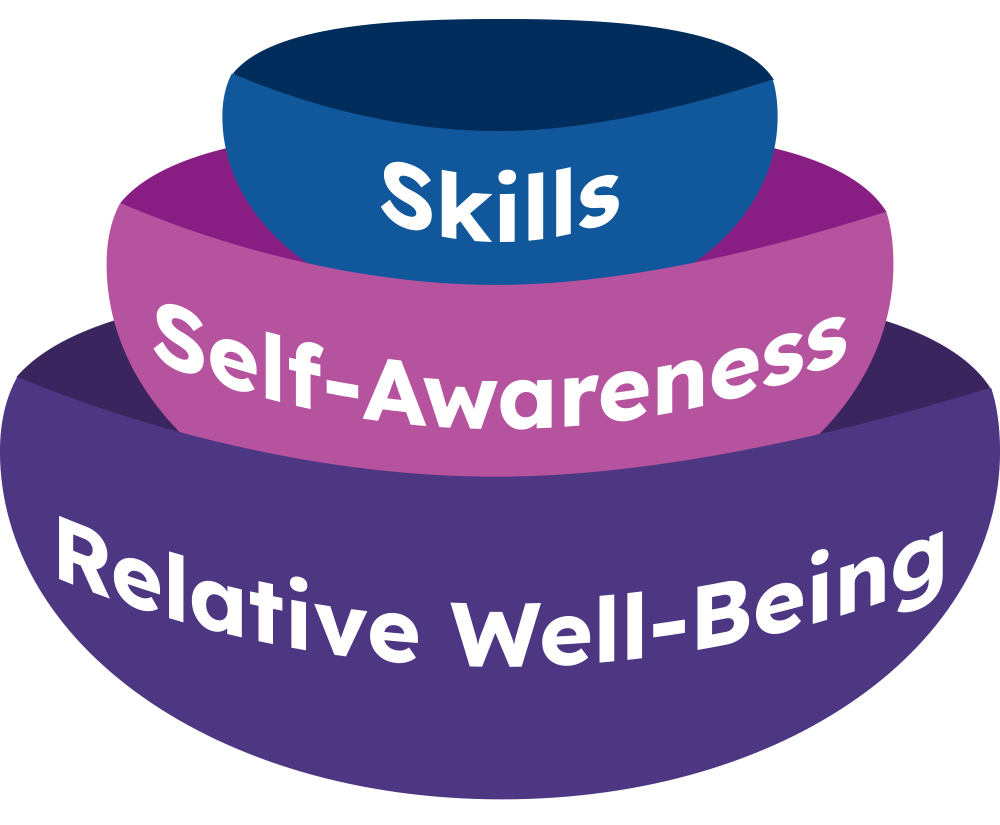
The Three Bowls
This is a model of keeping oneself well while doing difficult work, especially regarding secondary trauma. It is called a holarchy, different from a hierarchy in that the one at the top is not the most important. The second thing about a holarchy is that each bowl is contained within the larger bowl below it, so it cannot expand beyond the bounds of the bowl beneath it. This is based on Leticia Nieto’s (2010) use of Ken Wilbur’s (1996) work on holons and the Kosmos.
Often we try and fill the skill bowl to meet deficits in the relative well-being bowl. For instance, when a lack of trusting relationships shows up as an issue with ‘communication.’ So we ask people to improve their communication skills rather than attend to the wellness of the relationship. In fact, we need to attend to the largest bowl, our relative well-being so that we can actually draw upon and use the broadest set of skills we have in our skill bowl. And we do that through cultivating self-awareness and self-knowledge and we must balance our skill development with ongoing reflection and self-care.